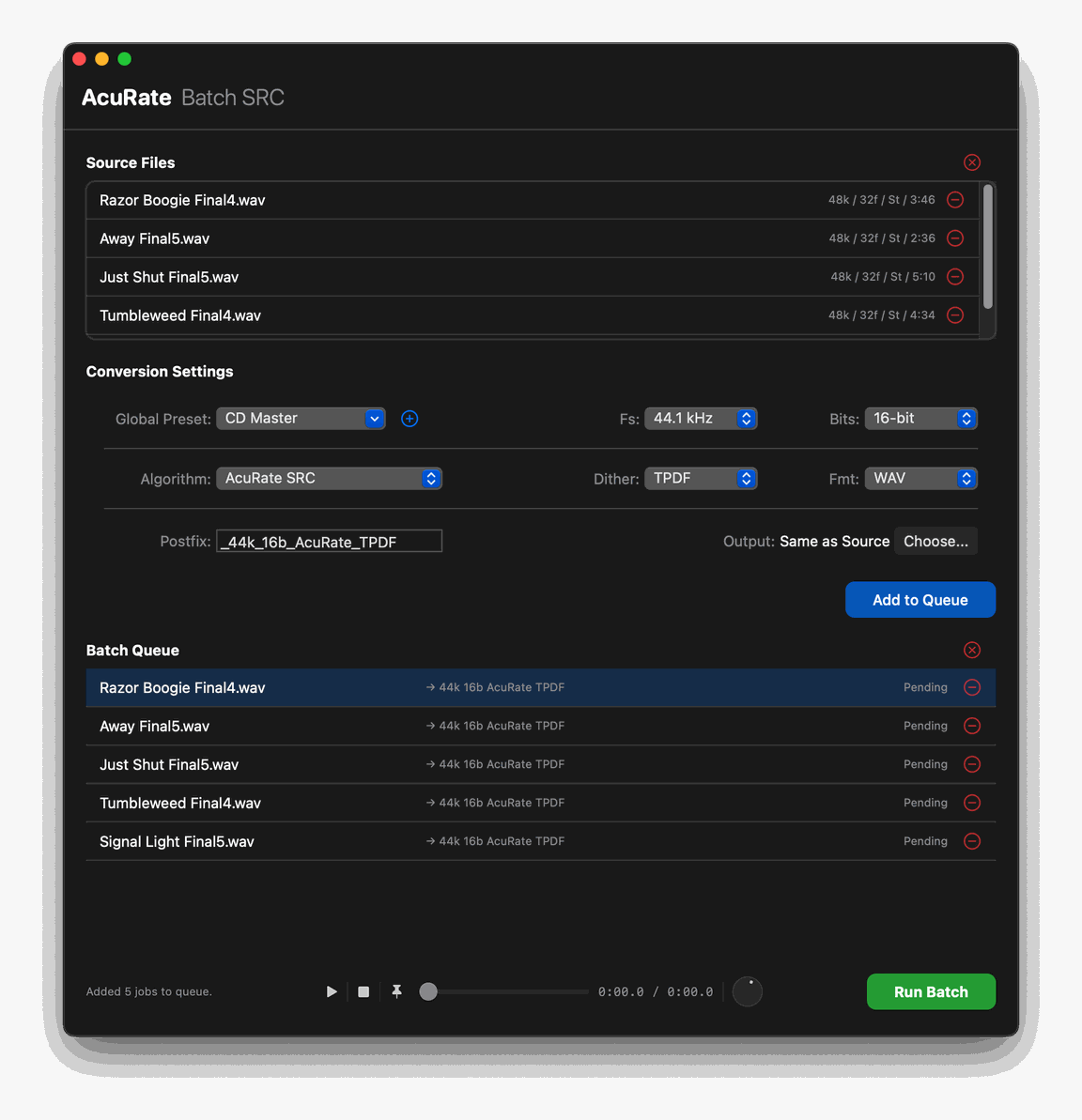
A batch sample-rate and bit-depth converter for macOS mastering delivery. Drop the files in, choose the engine, the target rate, the word length and the dither, and render — the whole path runs in 64-bit floating point, source file to output file.
Five engines, each with published numbers, and a preview that plays the one that will write the file.
I've spent 30+ years in the studio as a producer and drummer. I always wanted to finalize the work under one roof — clear, fast, and high quality — while keeping control over what sample-rate conversion does to the sound.
Finito is the flagship, for DDP and vinyl authoring. AcuRate does one thing: down- and up-conversion at the highest quality I could build, with the filter behaviour written down rather than left for you to guess at. One person writes it and answers for it, which is also why it is a one-time price with no dongle and no subscription.
— Martin Migash, migashaudio
Named engines, published numbers, and the settings that produce them.
Linear-phase polyphase FIR, cut-off at exactly −6 dB on the lower Nyquist, 128 taps per phase — a window of roughly 2.7 ms at 48 kHz, so pre-ringing stays as short as a linear-phase design allows. Stop-band attenuation of −127 dB, with passband ripple orders of magnitude below audibility.
AcuRate SRC and Swiss Reference are in-house designs on a 64-bit polyphase core. SoX VHQ, r8brain Free and SSRC Shibata are the original open-source converters compiled in unchanged — not re-implementations — so their output is bit-exact with the stand-alone tools. You pick the character that fits the material.
TPDF at ±1 LSB, decorrelated per channel, or ATH-curve noise shaping in three strengths for 16-bit targets. It is the last step after the conversion, at the exact target word length; float and 32-bit integer outputs are never dithered. Dither is set per job, so you always know which one hit which file.
Each job freezes the settings it was created with, so one batch can carry several deliverables: queue the album at CD Master, switch to Hi Res, queue it again, render once. Six built-in presets — CD Master, Hi Res, Streaming, Video/DVD, Blu-ray, Audiophile — plus your own.
Every output is named from the recipe that made it — _44k_16b_AcuRate_TPDF — so a folder of deliverables says what is in it. Add your own suffix and it survives every settings change. Sources are decoded straight to 64-bit float, with no 32-bit intermediate on the way in.
The transport plays a queued job through the very engine that will render it — same code, same dither, no draft mode — so engines can be compared on the material rather than on their descriptions. The output device is switchable in the app.
Three of the five are the original open-source converters, compiled in unchanged. Their figures are the published ones; the two in-house engines are measured the same way.
| Engine | Design | Measured |
|---|---|---|
| AcuRate SRC | In-house linear-phase polyphase FIR, 128 taps per phase, cut-off at −6 dB on the lower Nyquist. | −127 dB stop-band; window ≈ 2.7 ms at 48 kHz. |
| Swiss Reference | Calibrated to a legendary Swiss-built mastering converter. At 48 → 44.1 kHz it runs a directly extracted reference filter table — 147 phases × 110 taps in 64-bit — with a calibrated start phase. Other rate pairs use individually calibrated designs, 58 to ~930 taps, with the fractional phase offset baked into the filter rather than interpolated. | Nulls against the reference at −101 dB — the noise floor of the comparison itself. |
| SoX VHQ | The original libsoxr, driven with the very-high-quality recipe — the exact processing of the classic command-line tool. | ≈ −175 dB alias rejection, 95 % passband. |
| r8brain Free | The original r8brain-free-src as published; a very steep transition band. | −160 dB class, passband to 98 % of Nyquist. |
| SSRC Shibata | The original SSRC 1.33 high-precision build, run over the whole file exactly as the classic release. The lineage the Shibata noise-shaping curves come from. | Whole-file processor, so preview renders once in the background, then plays the finished result. |
At equal rates SoX VHQ, r8brain Free and SSRC Shibata pass audio through bit-identical with no filtering; AcuRate SRC and Swiss Reference still run their filter bank as a 1:1 polyphase pass. All five are auditionable in real time from the queue.
Four points where it takes a different approach to the resampler already in your DAW or converter.
| Parameter | A typical resampler | AcuRate |
|---|---|---|
| Engine control | One fixed algorithm, chosen for you. | Five engines, switched per job and auditionable. |
| Measured accuracy | Figures generally not published. | Per-engine figures published above; −127 dB stop-band. |
| Dither | One setting for the whole output, if any. | TPDF or ATH noise shaping, per job, applied once. |
| Licensing | Bundled with hardware, or a four-figure suite. | €59 once, two machines, no dongle, no subscription. |
Download and run. Demo mode is the full application with no time limit — every engine, every setting, the whole batch queue. Until you activate, a 0.4-second mute is placed every 10 seconds, on both playback and rendered files, so the quality is fully audible but the output is not usable for delivery. Nothing is embedded in the file itself.
The build is signed but not notarized by Apple, so on first launch right-click the app and choose Open — or, on macOS 15 and later, allow it in System Settings → Privacy & Security. The checksum below is there so you can confirm the file you downloaded is the file I published.
Because at delivery the conversion is the last thing that touches the audio, and it is worth knowing which filter did it. AcuRate lets you pick the engine, hear the difference on your own material before rendering, and read the figures for each one. If your DAW's resampler suits the material, that is a legitimate answer — but it is then a choice rather than a default.
A 0.4-second mute every 10 seconds, with click-free edges, on playback and on rendered files alike — the first one lands ten seconds in, so short passages start clean. Nothing is embedded in the file, no noise or tone is added, and the conversion itself is exactly what a licensed copy produces. There is no time limit on the demo.
Yes. libsoxr, r8brain-free-src and SSRC 1.33 are compiled into the app as published, not re-implemented, and driven with the classic settings — the output is bit-exact with the stand-alone tools. Their licenses ship inside the app, and the source for the LGPL components is available on request.
Last, once, at the exact target word length, after the sample-rate conversion. Float and 32-bit integer targets are never dithered. If the file goes on to be processed elsewhere, deliver it in 24-bit or float with dither set to None and let the final stage in the chain do it.
A license covers two machines. When one is replaced, retired or dies, email me and I free the seat — there is no re-purchase. The app never goes online to check anything; it verifies the license file offline, so it keeps working on a studio machine that has no network at all.
Not within the current major version. Every 1.x release is free — download the latest DMG and it runs with the license you already have, with nothing to re-activate. A future major version would be a paid upgrade.
Not for a disc. Finito carries the same engines for the material inside a project. AcuRate is for everything that is not a disc: batches of deliverables, alternate rates for streaming and video, a folder of files at once.
Enter the email from your purchase and the Machine ID from the app. I'll email your license to that address — then paste it into the app (AcuRate → Register).
Your Machine ID is already filled in below. Buy from here and your license is issued and emailed automatically — nothing else to fill in.
Buy AcuRate — €59The app never connects to the internet to activate — you enter the Machine ID here, and it verifies the license offline.